Showing posts with label filters. Show all posts

Monday, April 8, 2013

I'm Going Bananas Over Photoshop Elements

Open original picture, duplicate layer, and remove background.


Original Picture

Enhance>Adjust Colour>Remove Colour
and
Filter>Artistic>Cutout (7, 2, 2)

Colour Removed and Cutout Filter Applied

Add an Adjustment Layer, with a Solid Colour, Blend Mode: Multiply, 100% Opacity
and
go back to the Image Layer and Change the Opacity to 50%


Red Banana
Add a new layer at the very top (above the solid colour adjustment layer) and using the magic wand and paint bucket, fill in bright yellow where the banana was white.

Yellow Painted On Top
Flatten this Layer and copy the image into a new larger file (twice as wide and twice a high). Then, go back and undo flatten, change to blue solid background and repeat for the green and yellow bananas.

I hope Andy Warhol is Flattered


http://www.coskunfineart.com/Andy-Warhol-Screenprints.pdf

The Golden Crown

Filters are so much fun.

Original
Filter>Artistic>Dry Brush
Filter>Artistic>Poster Edges
Filter>Brush Strokes>Accented Edges

Friday, March 22, 2013

Chives

This is why I think chives are awesome:

  • first edible plant to come up in the spring, so welcome after the bleak winter
  • don't mind a cold, wet spring (which is highly probable)
  • honeybees like them. I like to help honeybees out as much as I can.
  • are an Allium and I love Alliums
  • bring back fond memories for me. I remember Tato asking me to go snip some "schneetleek" to sprinkle on our homemade chicken soup and it was one of my favourite "grown-up" tasks and I was so proud. "Schnittlauch" is the German word for chives, but until today I thought it was a Czech word. Apparently "pažitka" is the "new" (to me and probably to my Tato but I can't ask him) word for chives in Czech. I'm wondering if perhaps this is due to czechification that happened after WWII.
  • great topping for baked potatoes. Only freshly-snipped will do, dried chives taste like cardboard and don't even think about freezing them.
  • plants spread well, which may or may not be a good thing
  • divide easily. I was given this plant (rather its mother to be more accurate) by my neighbour to welcome us when we moved in, so it holds happy memories for me.
  • do not get out of control unless you want them to (as evident in the border picture)
  • thrive in any soil
  • don't need pampering, i.e. I never water or fertilize
  • will grow well in a pot. My Mom enjoyed fussing over hers on her small balcony, even though it didn't need much fussing.
  • are easy to prune, just shear them off after blooming and they will send up fresh new leaves. I try to do this before the rain beats them down, or before they go to seed because otherwise there will and explosion of millions of seeds everywhere.
  • flowers are edible too, tear them apart and they will be less oniony-tasting or at least you will get less on your tongue all at once
  • flowers make a nice garnish on any plate
  • make a great subject for Photoshop


Chives Are So Easy To Grow
Chives Make a Great Border
Filter>Artistic>Watercolour
Filter>Artistic>Palette Knife
Filter>Artistic>Smudge Stick
Filter>Distort>Diffuse Glow

Monday, March 11, 2013

What is Sumi-e?

I ran across the word Sumi-e while playing around with Filters in Photoshop.

Oriental brush painting originated in China centuries ago. It spread to Japan where it became known as sumi-e. Sumi means ink and e means picture.

Whenever I think of Asian art, the first thing that comes to mind is bamboo and I remembered that I had taken a photo of this gorgeous black bamboo that stands out so vividly against the white wall of the Dr. Sun Yat Sen Chinese Garden in Vancouver's Chinatown. I remember thinking when I took the photo that it reminded me of the time I attended a Chinese Art workshop at the Chinese Cultural Centre. The woman taught us how to make a painting of bamboo by giving us a brush, water and an ink block and after showing us how to load our brush, we had to practice how much pressure to apply and how much water to use, painting at first on newspapers - and she would say "go, go, go, go, stop" and at the word "stop" we would lift up the brush and that would be the first joint in the bamboo. Then she would repeat the words "go, go, go, stop" and once again at the word "stop" we would lift up the brush and that would be the second joint in the bamboo. The kids couldn't stop giggling.

Original 1

Filter>Brush Strokes>Sumi-e

I liked it so much I sumi-e'd my other bamboo pic. Interestingly, the paint strokes out of which most paintings can be made are called the Four Gentlemen; these are the bamboo, the orchid, the plum tree and the chrysanthemum. Sumi-e instructors will insist that these be mastered before you progress.

Original 2
Filter>Brush Strokes>Sumi-e
For both of the sumi-e pics, I left the default values:

  • Stroke width 10
  • Stroke pressure 2
  • Contrast 16

because any other values looked awful.

The summer bouquet is the very first pic I chose this filter on. The result is quite pleasing but sumi-e looks its best on a pic with one or two colours.
Filter>Brush Strokes>Sumi-e

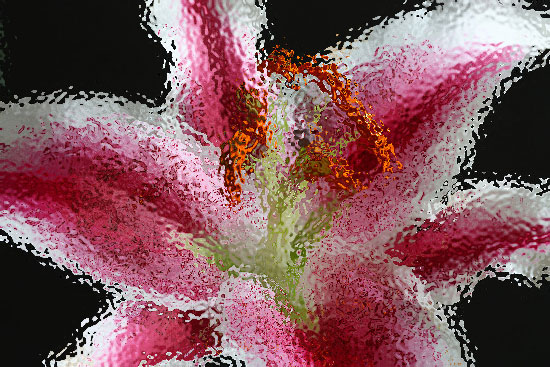
Stargazer Lily Makes a Great Subject for Filter Fun

The effects of the various filters available in Photoshop show up really well on a single subject. I had seen a Stargazer Lily being used in one of my reference books and I thought I'd like to try it out myself. Here are some interesting filters that I applied (in alphabetical order):

Under Filter>Artistic:

Coloured Pencil
Paint Daubs
Plastic Wrap
Rough Pastels
Smudge Stick
Sponge
Watercolour
Under Filter>Brush Strokes:
Ink Outlines
Under Filter>Distort:
Diffuse Glow
Glass

Under Filter>Pixellate:
Mosaic

Pointilize
Under Filter>Render:
Difference Clouds
Under Filter>Sketch:
Chalk and Charcoal
Under Filter>Stylize:
Emboss
Glowing Edges
Solarize
Under Filter>Texture:

Craquelure
Craquelure refers to the hairline surface cracking of paintings into characteristic texture patterns determined by climate conditions and materials used in the creation of the painting. In the 18th century, Craquelure was so popular that to English painters it became known as Craquelure anglaise. Today, forgers and restorers often imitate it to enhance the look of authenticity in their works.
Patchwork
Stained Glass


Variations of a Summer Bouquet

Photoshop's Impressionist Brush sounded interesting to me so I opened up a pic that I took last summer and tried it out. The Impressionist Brush tool is similar to some of the Artistic and Brush Stroke filters, but instead of selecting the entire pic, one can "paint" over just certain parts.

Original
This is what happens when you use the Impressionist Brush from the Toolbox:
"Paint" over the pic with the Impressionist Brush
This reminds me of  a watercolour
I thought I'd try out a few filters while I had the file open and here are a few of my favourites:
Artistic>Palette Knife
I'd like to print this on canvas just as is
Artistic>Poster Edges (maximum settings)

Artistic>Poster Edges (minimum settings)
I like this one better
Posterized - Level 4
This is quite a lot more dramatic than the next one which was at a lower level

Posterized - Level 2
Brush Strokes>Sumi-e
Sumi-e is a classical Asian ink painting that focuses on simple lines and open space. This does not look like sumi-e but I like it.